

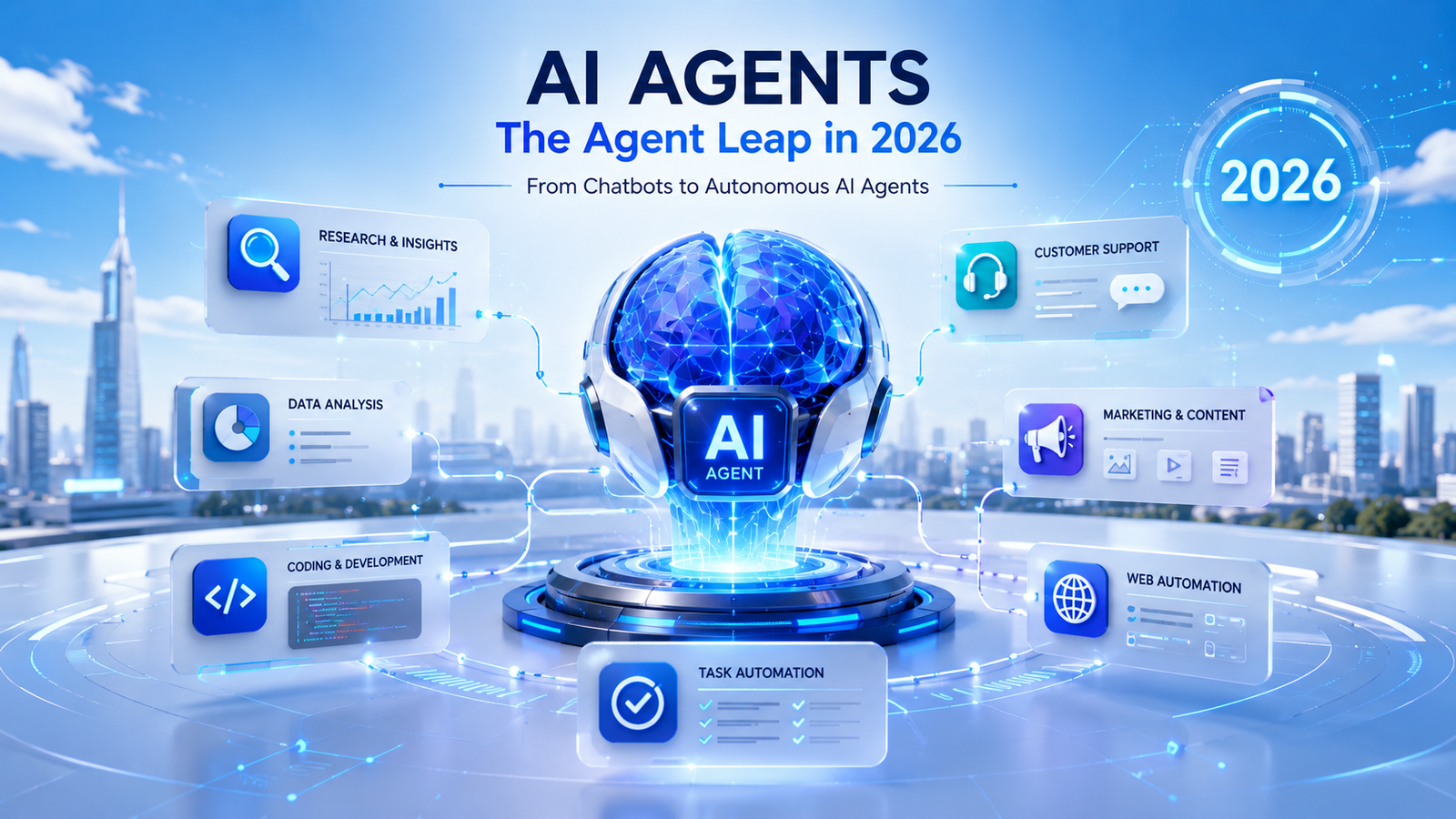
Introduction: From Chatbots to Co-Workers
Till a couple of years ago, using AI meant one simple pattern: you typed a question, and the AI gave you an answer. That’s it. But if you’ve been following AI news in 2026, you’ve probably noticed a new buzzword everywhere — “AI agents.” Industry researchers are even calling this shift “the agent leap,” and it’s one of the biggest changes in how AI works since chatbots first went mainstream. If you’re still fuzzy on the basics, our guide on AI meaning in simple words is a good place to start before diving into agents.
So what exactly is an AI agent, why is everyone talking about it right now, and does it actually matter for students and everyday AI users? Let’s break it down with real examples.
What Is an AI Agent, Really?
A regular AI chatbot is passive. You ask, it answers, and the conversation ends there. It doesn’t take any action on its own.
An AI agent is different. According to Anthropic’s own engineering explanation of multi-agent systems, an agent is essentially multiple AI models using tools in a loop, working together — often in parallel — to complete complex tasks. Instead of just replying, an agent plans a task, breaks it into steps, uses tools (like browsing the web, running code, or connecting to an app), and carries out the entire task with very little supervision from you. Think of the difference between asking a friend for directions versus asking them to actually drive you there, handle the tolls, and drop you off. That’s roughly the jump from a chatbot to an agent.
Why 2026 Is Being Called “The Agent Leap”
A few things changed together in 2026 that pushed agents from an interesting demo into something businesses actually rely on:
- Multi-agent systems: Research firm Gartner has projected that roughly 40% of enterprise applications will include task-specific agents by 2026, up from under 5% just a year earlier. Instead of one AI doing everything, specialized agents — a planner, a researcher, an executor, a verifier — now divide the work like a real team.
- Persistent memory: Agents can now remember context across sessions instead of forgetting everything the moment you close the chat. Industry data cited by enterprise AI vendors has linked stronger memory architectures to roughly 26% better accuracy along with lower latency and cost.
- Cross-agent communication: Google introduced the Agent2Agent (A2A) protocol in 2025 and it saw major enterprise adoption through 2026, letting agents built by different companies communicate and coordinate securely across platforms — so a scheduling agent can hand off part of a task to a completely different vendor’s agent.
- Deep tool integration: Agents can now plug directly into everyday software — CRMs, ERPs, DevOps pipelines — and actually perform actions inside them instead of just describing what to do.
Real Examples: Where Agents Are Already at Work
This isn’t just theory — named, real-world agents are already doing serious jobs:
- Autonomous flight: In August 2026, DARPA completed the first real-world flight of a fighter jet fully controlled by AI, without a human pilot — a landmark test for autonomous decision-making under real-world pressure.
- Coding agents: Meta’s Muse Code, built on its Muse Spark 1.2 model, can write code, fix bugs, verify its own results, and run multiple sub-agents in parallel on the same project. It also keeps a full action history so it can resume work automatically after an interruption.
- Cybersecurity: Security company ExtraHop launched the Agentic SOC Alliance in 2026 with over 15 founding members, including CrowdStrike and Dropzone AI, to standardize how autonomous agents triage security alerts and coordinate threat response across different vendors’ tools.
- Customer service and HR: Industry reports on enterprise AI adoption note that in some healthcare deployments, agents are handling the large majority of routine patient service interactions — from identity verification to appointment scheduling — start to finish, with similarly high containment rates reported in HR and IT helpdesk use cases.
The Risks Nobody Should Ignore
As exciting as this sounds, the agent leap comes with real concerns that even the companies building these tools are flagging:
- Mistakes scale faster: Because agents act on their own, a small error can multiply quickly across a workflow before a human notices it — this is why “human-in-the-loop” checkpoints are becoming standard for anything touching money, legal decisions, or sensitive data.
- “Agent washing”: Not everything labeled an “AI agent” actually behaves like one — some products are simple automation with a trendy new name attached. Gartner has predicted that more than 40% of agentic AI projects started in the past couple of years will be cancelled by the end of 2027, largely over cost, risk, and unclear ROI.
- Safety governance is still catching up: A mid-2026 AI safety assessment from the Future of Life Institute found that no major AI lab scored above a C+ on safety practices, underlining how much work is left on the governance side even as agent capabilities race ahead.
What This Means for Students Learning AI
If you’re a student trying to stay relevant in the AI space, here’s the practical takeaway: knowing how to prompt a chatbot well is no longer enough on its own. Understanding how agents plan tasks, use tools, and hand off work to other agents is quickly becoming a valuable, in-demand skill — especially if you’re interested in tech, marketing, or business roles where AI tools are becoming standard. If you want a head start on the tool side of this shift, our roundup of free AI tools for students is a practical place to begin experimenting.
You don’t need to be a programmer to start understanding agents. Start by using agent-style AI tools yourself, notice how they break a task into steps, and pay attention to where they still need your oversight. That hands-on curiosity is exactly how most people are getting ahead of this shift right now.
Final Thoughts
The move from chatbots to AI agents is one of the most significant shifts in the AI world this year, and it’s only accelerating. Whether or not you work in tech, understanding what agents are, where they’re already deployed, and where their limits still lie will help you make sense of a huge chunk of AI news for the rest of 2026 and beyond.
Want to go deeper into how AI tools actually work? Explore more beginner-friendly guides right here on AI Study Point, including our AI Ethics & Bias guide for the responsible side of these fast-moving tools.
